








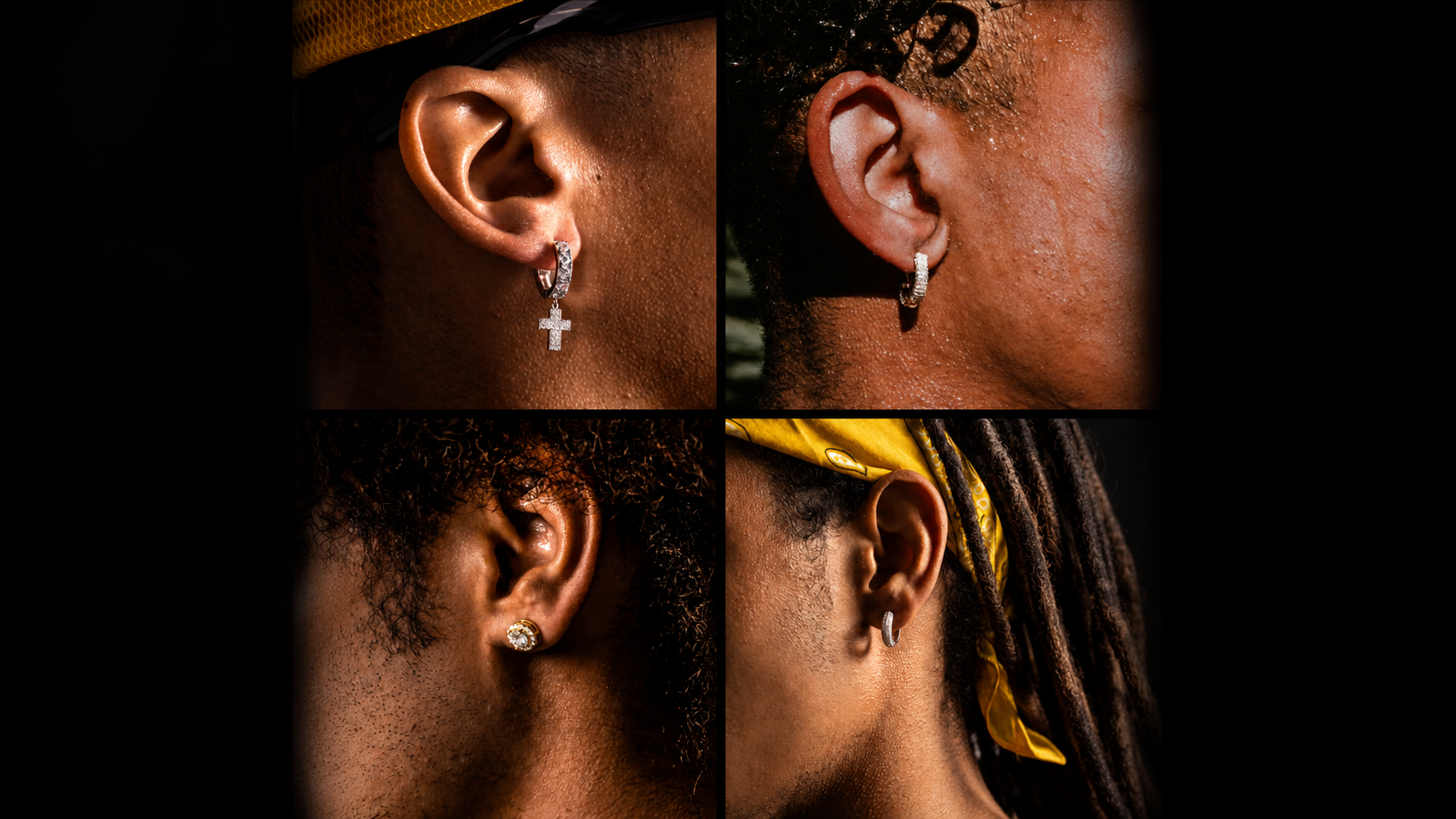
Quick Answer — What Earrings Do Men Wear?
Men most commonly wear studs, hoops, huggies, cross studs, and stone-set or dangly statement designs. Studs are the easiest everyday choice, hoops bring a classic streetwear shape, huggies stay close to the ear with minimal movement, while cross and stone-set pieces create a stronger focal point.
At APORRO, a strong first rotation starts with a small or regular stud, then adds a hoop or statement piece once you know what scale works with your face, wardrobe, and comfort. One earring or a matching pair both work — the right choice depends on the outfit and how much shine is already in play.
| Type | Shape on the ear | Movement | Everyday? | Best for |
|---|---|---|---|---|
| Stud | Sits flat on the lobe | None | Yes | First earring, daily wear, pairing with chains |
| Hoop | Open circle around the lobe | Moderate | Yes, in smaller diameters | Streetwear presence, framing the face |
| Huggie | Small hinged hoop, close fit | Minimal | Yes | Low-maintenance wear, second purchase |
| Cross stud | Compact shape, close to lobe | Low | Yes | Identity without a full statement |
| Dangly / iced | Drops below the lobe | High | Occasional | Night out, performance, shoots |
Check the Back Before You Check the Front
The single most important detail on a men’s earring is the part nobody photographs. Three back types exist, and the difference decides whether an expensive stud stays in your ear.
Friction backs, also called butterfly or push backs, hold by tension alone. They’re the industry default and the leading cause of lost earrings — tension slackens with repeated use, and a back that felt secure last month may not be. Fine on lightweight studs; risky on anything heavy.
Screw backs thread onto a grooved post. They take longer to put on and they don’t come off accidentally. For heavier stone-set studs, this is the right choice.
Locking or latch backs click into place and release deliberately, splitting the difference between security and convenience.
Hoops and huggies use their own hardware: hinged snap closures, latch backs, or continuous designs. A hinged huggie is generally the most secure everyday format on this list, since it closes on itself rather than relying on a separate component.
Post Gauge — The Fit Detail That Decides Everything
An earring post has a thickness, measured in gauge, and gauge numbers run backwards: higher number, thinner post.
Standard earring posts are 20 gauge, about 0.8mm, which is what a typical lobe piercing is made with and heals at. Some heavier designs use 18 gauge, about 1.0mm, which will not pass comfortably through a piercing that healed at 20g — forcing it damages the channel.
Before buying anything heavier than a basic stud, confirm the post gauge on the product page, and if you don’t know your own piercing size, a piercer can check it in under a minute. Post length matters too: thicker earlobes need longer posts, and a post that’s too short compresses the lobe and causes irritation.
Stud Earrings — The Everyday Essential
Studs sit directly on the lobe, adding a controlled point of shine with no hanging line. That makes them the most adaptable men’s earring — they work with a plain tee, hoodie, jersey, denim jacket, or a layered chain setup without making the ear the loudest element.
Size controls how a stud reads. A small round stud stays restrained and pairs easily with a wide chain or pendant. A medium stud becomes clearly visible in front-facing photos and under flash. A large halo stud creates a fuller stone-set look and should be treated as part of the main jewelry composition rather than an accent.
The Moissanite Halo Round Cut Stud Earring is offered from 7mm to 12mm. Its construction is a brass body with a 925 sterling silver post, white gold or 14K gold plating, and moissanite — plated brass with a silver post, not a solid sterling earring. The current product page states it is lead and nickel free.
On tone: white gold plating pairs with silver-toned chains; yellow gold adds warmth against black, cream, and vintage sportswear. When the necklace is already wide or heavily stone-set, size the stud down.
Hoop Earrings
Hoops create a visible circular frame around the lobe, introducing shape, open space, and movement that studs don’t. That suits streetwear and hip-hop styling when the fit needs presence around the face without a full dangly statement.
Three specs determine how a hoop reads. Inner diameter sets how closely it sits. Width controls visual weight. Stone layout separates a clean polished curve from paved, clustered, or baguette-set designs.
The S925 Round Paved Hoop Earrings list small and medium paved options at 9mm and 14.5mm inner diameters, in two distinct material structures: brass with moissanite on an S925 post, and 925 sterling silver with CZ. These are genuinely different products — body metal and stone type both differ — so compare the specific option rather than the product name. Price varies by material, size, quantity, and color.
For a balanced streetwear fit, pair a medium hoop with one clear neckline decision: a plain chain, a smaller pendant, or an open collar. If both the hoop and the necklace are heavily stone-set, pull back elsewhere.
Huggie Earrings
A huggie is a compact hinged hoop, usually under 10mm inner diameter, that closes tightly around the lobe with little or no drop. It sits between a stud and a standard hoop: more shape than a stud, less movement than a full hoop.
The close fit is the practical advantage — huggies are far less likely to catch on hair, collars, hoodies, or headphone bands, which makes them genuinely low-maintenance. The hinged closure is also more secure than a friction back.
Two honest caveats. Fit depends heavily on inner diameter relative to earlobe thickness, so a huggie that hugs one ear may pinch or gap on another. And APORRO doesn’t currently organize a separate huggie collection — compare the actual measurements and closure type on smaller hoop options rather than relying on the category label.
Cross & Statement Earrings
Statement designs split into two levels, and treating them as one category is why people buy the wrong one.
Light statement — cross studs
The S925 Eternal Cross Stud Earring uses a 925 sterling silver body, white gold plating, and CZ stones, at 6.3mm wide by 8.2mm long and 0.8g per earring. It carries more identity than a plain round stud while staying close to the ear, which makes it viable daily when the rest of the jewelry stays controlled.
Heavy statement — dangly and stone-set
A dangly earring adds length below the lobe and moves as you walk or turn. The Moissanite S925 Cross Dangly Earring uses 925 sterling silver, 18K white gold plating, and moissanite, with the hanging cross at 3.2mm by 10mm and the earring at 2.7g.
That 2.7g against the cross stud’s 0.8g is the whole story: more than three times the weight, hanging rather than resting. Weight on a lobe is cumulative over a day, which is why dangly designs suit events, shoots, and nights out rather than a default rotation. They also compete with glasses arms, longer hair, collars, and layered necklaces. Wear them when the rest of the fit leaves room.
Metal & Materials Guide
Earring descriptions have four separate components, and a product can differ on every one. Read them individually.
| Component | What it means | Why it matters |
|---|---|---|
| Body | The main metal of the visible earring (brass, 925 sterling silver) | Sets weight, durability, and price tier |
| Post | The metal passing through the piercing (often 925 silver even on brass bodies) | The only part in contact with broken skin — the sensitivity-critical component |
| Plating | Surface finish (white gold, 14K, 18K gold) | A wear layer, not the base metal; determines color and care |
| Stone | Moissanite, CZ, or none | Sets sparkle behaviour and price |
“Gold plated” describes the surface, never the metal underneath. A gold-plated earring may be sterling silver or brass at its core, and those are different products at different price points. Under the FTC Jewelry Guides, precious-metal and plating claims have to be accurate and must not imply more precious-metal content than the piece contains.
On nickel, specifically. Nickel is the most common contact allergen in the world, and earrings are the highest-risk jewelry category for it because the post sits inside a break in the skin rather than against its surface. Nickel is a common alloying element in brass and in some plating layers, which is why lead-and-nickel-free declarations matter more on earrings than on a chain or ring. If you’ve reacted to jewelry before, the specification to check is the post — not the body, not the plating color.
Prices vary by material, size, quantity, and color; confirm on the product page before purchase.
Sizing & Fit
There’s no single correct size. Balance is set by face shape, outfit, and comfort.
Face shape. Round or square faces gain from a narrow dangly design or an angular stud that introduces a vertical or sharper line; very large round hoops can echo width that’s already there, so a medium hoop or a directional shape balances better. Longer or slimmer faces carry fuller round studs and classic hoops well, because those shapes add visible width. When in doubt, a regular stud or medium hoop is the lowest-risk default. Hair volume, glasses, facial hair, hats, and neckline width all shift how the same earring reads.
Outfit. Everyday streetwear: regular stud, close hoop, huggie shape, or medium paved hoop. Quieter: small stud. Statement or night out: cross stud, stone-set hoop, dangly cross, or a single-ear asymmetric design. When the earring leads, remove one other high-impact element.
Comfort. For all-day wear, prioritize low weight, close fit, and minimal movement. For occasional wear, size and impact can take priority. Check whether a product is sold as a single or a pair — the same design reads very differently on one ear versus two.
Which Ear? The Honest Answer
This is one of the most-searched questions in men’s earrings, and it deserves a direct answer: it doesn’t signal anything, and you can wear either or both.
In the 1980s and 90s, Western folklore held that the right ear signalled gay identity and the left signalled straight. That code was never consistent, varied between countries and scenes, and is culturally obsolete today. Nobody reads ears that way now.
What does inform the choice is practical. Single-ear wearing is standard across streetwear and hip-hop styling, and a single earring reads as deliberate when the shape holds up on its own — a stud, a compact hoop, or a cross stud. If you’re wearing one, pick the side that doesn’t fight your part, your glasses, or the side you sleep on. If you’re wearing two, matched studs are the safe default and matched hoops the confident one.
Best Men’s Earrings by Use Case
| If you want… | Choose | Why |
|---|---|---|
| A first earring | Small to regular stud | Lowest risk, pairs with everything, teaches you your scale |
| Daily wear you forget you’re wearing | Stud or huggie | Minimal weight and movement, won’t catch on collars or headphones |
| Streetwear presence | Medium paved hoop | Shape and shine around the face without a hanging drop |
| Identity without volume | Cross stud | Recognisable form, stays close to the lobe |
| A night-out statement | Dangly cross or stone-set hoop | Movement and length read under low light and on camera |
| A single-ear look | Stud, compact hoop, or cross stud | Shape stays legible alone, without excess swing |
| Sensitive ears | Check the post spec first | Post metal, not body or plating, is what sits in the piercing |
| To wear with a wide chain | Small stud | Keeps the neckline as the lead element |
Aporro Earring Picks by Style
The everyday stud — the Moissanite Halo Round Cut Stud Earring from 7mm to 12mm, plated brass with a 925 silver post and moissanite. Start at the smaller end unless the ear is meant to lead.
The streetwear hoop — the S925 Round Paved Hoop Earrings at 9mm or 14.5mm inner diameter, available as brass with moissanite or 925 sterling with CZ. Choose the material spec deliberately; they’re different products.
The daily statement — the S925 Eternal Cross Stud Earring, 925 sterling with white gold plating and CZ, 0.8g. Light enough to forget, distinct enough to notice.
The night-out piece — the Moissanite S925 Cross Dangly Earring, 925 sterling with 18K white gold plating and moissanite, 2.7g. A planned statement, not a default.
Explore APORRO men’s earrings for the full range, or build the wider rotation through men’s jewelry.
Frequently Asked Questions
What earrings do men wear?
Studs, hoops, huggies, cross studs, and dangly or stone-set statement designs. Studs are the easiest daily option, hoops add streetwear shape, huggies minimize movement, and statement designs work when the earring is meant to lead the fit rather than support it.
Are hoop earrings or studs better for men?
Studs for a first rotation and everyday wear — they sit close and combine easily with chains and pendants. Hoops when the outfit needs shape and presence around the face. For night-out styling, a paved hoop, cross, or dangly design.
What size earrings look best on men?
Size to your face and lobe scale rather than to a number. Small studs read controlled; medium and large studs are clearly visible from the front. As reference points from the products above, the halo stud runs 7mm to 12mm and the paved hoop offers 9mm and 14.5mm inner diameters.
Which ear should a man wear an earring in?
Either. The 1980s–90s left/right code was never reliable and carries no meaning today. Choose by practicality — the side that doesn’t conflict with your part, glasses, or sleeping side — or wear both.
What’s the difference between friction backs and screw backs?
Friction backs hold by tension and are the most common cause of lost earrings, since tension loosens with use. Screw backs thread onto the post and won’t come off accidentally, which makes them the right choice for heavier or more valuable studs. Locking backs sit in between.
What post gauge do men’s earrings use?
Standard posts are 20 gauge, roughly 0.8mm — the size most lobe piercings heal at. Some heavier designs use 18 gauge (about 1.0mm), which won’t pass comfortably through a 20g piercing. Check the listed gauge before buying anything substantial, and never force a thicker post.
What metal is best for men’s earrings?
Full 925 sterling silver — body and post — is the clearest starting point. Gold-plated earrings may be sterling or brass underneath, so the full specification matters more than the visible color. If you’re sensitivity-prone, the component to check is the post, since nickel is the most common contact allergen and the post is what sits inside the piercing.
Are men’s earrings suitable for everyday wear?
Yes. Small or regular studs, close-fitting hoops, and compact cross studs all work daily. Start with low weight and minimal movement, then scale up once you know what stays comfortable through a full day.
Can men wear one earring only?
Yes — a single earring is standard in streetwear and individual styling. Hoops and cross studs hold a single-ear look well because the shape stays legible without excess swing. A single dangly works too, but the asymmetry should be supported by the rest of the outfit.
What’s the difference between a huggie and a hoop?
A huggie is a small hinged hoop that closes tightly around the lobe with minimal open space or drop. A standard hoop has a larger inner diameter, a clearer circular outline, and more movement. The hinged closure also makes huggies more secure than most friction-back studs.
Are stone-set earrings too much for daily wear?
Not automatically. A small stone-set stud or compact paved hoop works daily when weight and dimensions stay controlled. Large paved hoops, hanging crosses, and chain-drop designs create more movement and are better treated as planned statement pieces.
Share:
The Most Durable Men's Chains: Which Ones Actually Last (2026 Guide)
Best Men’s Gold Pendants — Styles, Sizing & Buying Guide (2026)